SONARIQ / APPLICATIONS
Windows & Android applications.
I choose technologies and methods around the product’s performance and business requirements. I combine a fast interface, stable architecture, cloud integrations and — when the project needs it — native real-time processing.
Explore the SONARIQ JW-2 synthesizer ↓
01 / SONARIQ JW-2Synthesizer SONARIQ JW-2 (Android)
A focused Android synthesizer for real-time sound design, combining a native audio engine with a clear, performance-oriented interface.
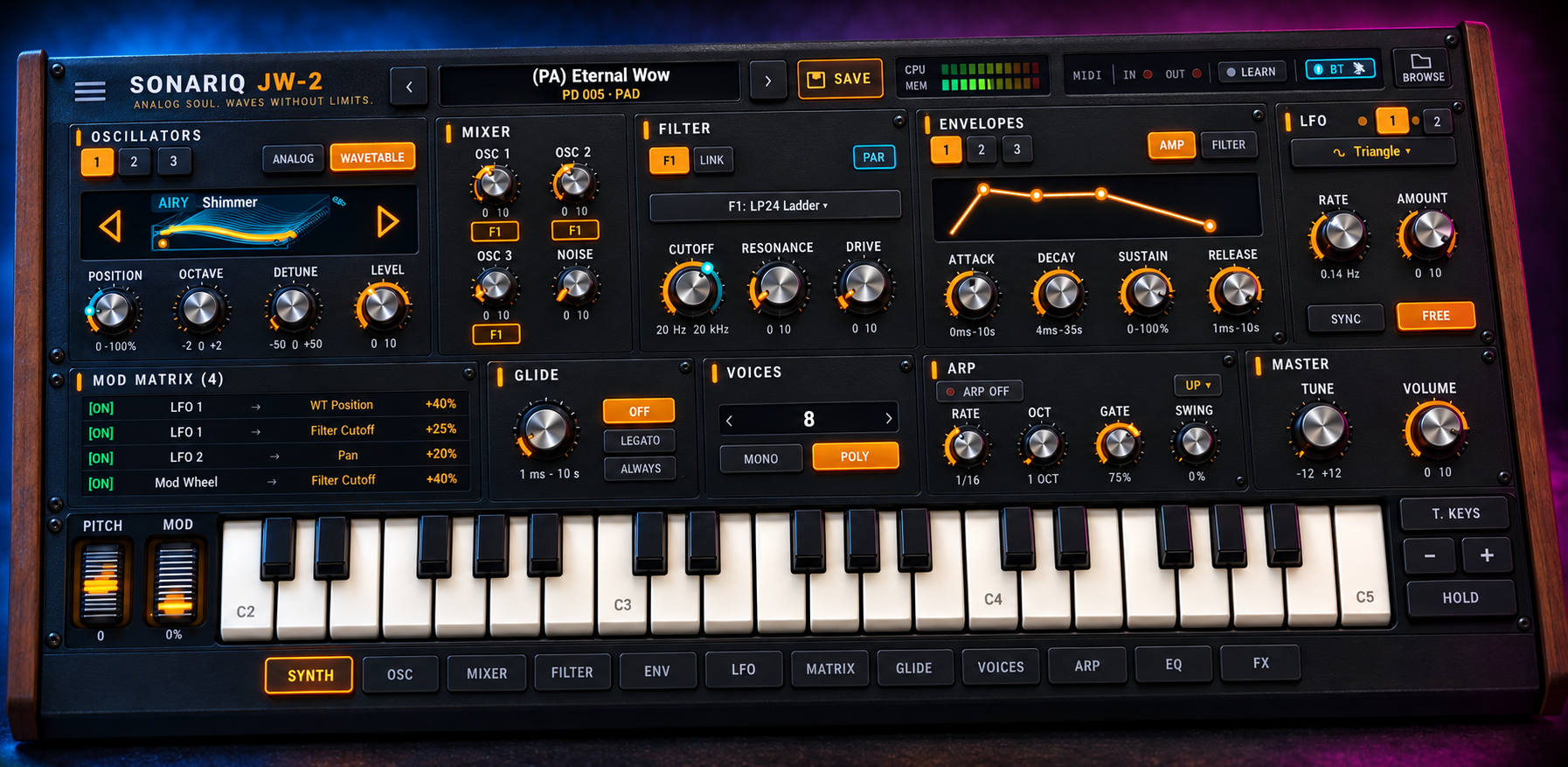
SONARIQ JW-2 is a hybrid instrument with up to eight voices, combining virtual analogue and wavetable synthesis, including FM-style wavetable timbres, with dual zero-delay-feedback filters, a resonant 4-band equalizer and a complete stereo effects bus. The engine exposes 123 synthesizer parameters, giving musicians detailed control over the signal path, modulation, performance behaviour and preset design.
Complete signal path, from oscillator to master output.
Each voice starts with three oscillators and a pink-noise generator, passes through the mixer and pre-filter saturation, then reaches the filter and output stages. Up to eight active voices are summed to a stereo master bus, where EQ, drive, chorus, delay, reverb and output soft clipping shape the final sound.
The Android implementation uses a C++20 real-time audio engine with Android NDK, CMake, JNI and Google Oboe / AAudio, paired with a Kotlin and Jetpack Compose interface. Presets and MIDI mappings are stored locally on the device.
Synthesis engine and oscillators
- Architecture
- Up to eight voices of Virtual Analog and Wavetable synthesis with per-voice processing. Wavetable banks also include FM-style timbres.
- Oscillators
- Three oscillators per voice. OSC 1 and OSC 2 use VA PolyBLEP waveforms or wavetable mode; OSC 3 supports VA and wavetable operation, with an additional Lo Mode setting for low-frequency operation.
- Waveforms
- Triangle, saw, TriSaw, square, wide pulse, narrow pulse and wavetable. Wavetable frames are blended linearly; waveform samples are read using cubic Hermite interpolation.
- Wavetables
- 36 banks, each with 16 spectral frames, covering airy, digital, FM and bells/metal timbres.
- Additional sources
- Pink-noise generator, per-oscillator tuning in semitones and cents, octave/range controls and independent oscillator levels.
- Drive
- Pre-filter drive with asymmetric saturation using a fastTanh-style curve for additional analogue-style harmonics.
Dual filter system
- Filter topology
- Two independent Zero-Delay Feedback filters with 2× oversampling. Each filter supports LP12 SVF, LP24 transistor ladder, BP12 SVF and HP24 ladder modes.
- Filter controls
- Cutoff range 20 Hz–20 kHz, resonance, drive, key tracking and dedicated filter-envelope amount and ADSR controls.
- Routing
- Parallel or serial routing, selectable serial direction F1→F2 or F2→F1, linked cutoff control and per-oscillator routing to F1, F2 or both.
- Character
- LP12 preserves the low-end foundation; LP24 provides a 24 dB/octave ladder response with self-oscillation at high resonance; BP12 creates vocal/formant tones; HP24 removes the low end for radio, laser and clean-up effects.
Envelopes and performance
- Envelope architecture
- Each of the three oscillators has dedicated amplifier and filter ADSR envelopes. Velocity and tremolo modulation also affect the voice output.
- Time ranges
- Envelope attack reaches 10 seconds, decay 35 seconds and release 10 seconds, with short settings available for plucks, basses and percussive sounds.
- Voice modes
- Polyphonic or monophonic operation, configurable from 1 to 8 active voices, with retrigger/legato behaviour and last-note or high-note priority.
- Glide and tuning
- Off, Always or Legato glide; constant-time or constant-rate portamento; master tuning ±12 semitones and pitch-bend range ±2 semitones.
- Unison
- Voice detuning up to 50 cents and adjustable stereo width for wide pads, leads and layered basses.
Dual LFO and modulation matrix
- LFO 1 and LFO 2
- Seven shapes: sine, triangle, saw up, saw down, square, sample & hold and smooth random. Rate range 0.01–50 Hz plus tempo-sync divisions from 1/1 to 1/32, dotted and triplet values.
- Advanced LFO control
- Phase 0–360°, bipolar or unipolar polarity, free/retrigger/one-shot trigger, poly or global voice mode, delay and fade-in up to 10 seconds, pulse width and smoothing up to 500 ms.
- Sources
- 12 modulation sources: LFO 1, LFO 2, modulation and amp envelopes, velocity, key tracking, mod wheel, aftertouch, random-per-note, sample & hold and two macro controls.
- Matrix
- Four modulation slots with amount −100% to +100%, unipolar/bipolar polarity, linear/exponential/logarithmic curves, optional Via source and smoothing.
- Destinations
- Targets include oscillator pitch and fine tuning, wavetable position, levels, both filters, amplitude and pan, plus selected chorus, delay, reverb and EQ parameters.
Master effects and 4-band EQ
- FX chain
- Master overdrive → stereo quadrature chorus → ping-pong delay with sync, time, feedback and damping → FDN Space Reverb with decay, size, pre-delay, damping and modulation.
- Equalizer
- Four stereo biquad sections: low shelf, Mid 1 resonator, Mid 2 formant bell and high shelf. Each mid band supports Q up to 18 for narrow resonances.
- EQ ranges
- Frequency controls: Low 20–1000 Hz, Mid 1 40–4000 Hz, Mid 2 200–12,000 Hz and High 1000–20,000 Hz. Each band has −18 dB to +18 dB gain; mid-band Q ranges from 0.2 to 18. Warmth adds asymmetric harmonic saturation.
- Routing and monitoring
- EQ can run before the effects (PRE-FX) or after them (POST-FX). An oscilloscope displays the waveform monitored after the EQ; it is not a spectrum analyser.
- Output safety
- Master volume smoothing reduces abrupt level changes, while output soft clipping limits signal amplitude.
Arpeggiator, sequencer and control
- Arpeggiator
- Up, Down, Up/Down, Random, Chord and As Played modes; note divisions from 1/32 to 1/4, 1–4 octave range, 10–100% gate and 0–75% swing.
- 16-step sequencer
- Pattern lengths of 4, 8, 12 or 16 steps. Each step can play a note, rest or tie, with octave offsets from −2 to +2 and velocity accents from 0.2 to 1.2.
- MIDI and peripherals
- USB and Bluetooth MIDI connectivity, MIDI Learn for mapping hardware controls, pitch bend, mod wheel, aftertouch and velocity response.
- Preset model
- Preset data stores the 123 engine parameters together with modulation, dual-LFO and optional arpeggiator state. Categories include Bass, Lead, Pad, Pluck, Arp/Seq, FX and Keys.
- Android platform
- Native ARM64 and x86_64 builds through Android NDK and CMake, with Kotlin/Jetpack Compose UI and local preset storage. The app does not require an account.
Complete control surface
- OSC
- Three oscillator pages expose VA or Wavetable selection, waveform or bank choice, wavetable position, octave/range, detune, level and oscillator-to-filter routing.
- MIXER
- Independent OSC 1, OSC 2, OSC 3 and pink-noise levels, oscillator filter assignment and pre-filter drive control the balance and saturation of the sound sources.
- FILTER
- F1 and F2 pages provide cutoff, resonance, drive, key tracking, envelope amount, filter mode, link and serial/parallel routing controls.
- ENV
- Dedicated envelope pages provide graphical ADSR editing for amplifier and filter movement, with attack, decay, sustain, release and velocity-sensitive response.
- LFO
- Two LFO pages provide shape, rate, amount, phase, polarity, sync, trigger mode and free/retrigger/one-shot behaviour for cyclic modulation.
- MATRIX
- Four source-to-target rows provide amount, polarity, curve, Via and smoothing controls. Supported targets include pitch, wavetable position, filters, amplitude, pan, effects and EQ.
- GLIDE
- Portamento controls include glide time, Off/Always/Legato modes and constant-time or constant-rate behaviour for mono and legato playing.
- VOICES
- Voice controls select mono or poly operation, 1–8 active voices, note priority, retrigger/legato behaviour, unison detune, stereo width, tuning and master volume.
- ARP
- Arpeggiator and step-sequencer controls include mode, rate division, octave range, gate, swing, BPM, pattern length and per-step note, rest, tie, octave and velocity values.
- EQ
- Four stereo EQ bands include low and high shelves plus two bell-shaped mid bands with adjustable Q. Controls also include Warmth, PRE-FX/POST-FX routing and a waveform oscilloscope.
- FX
- Master effects controls cover overdrive, chorus, ping-pong delay and FDN Space Reverb, including on/off, sync, time, feedback, damping, decay, size, pre-delay and modulation.
- T. KEYS
- T. KEYS enables keyboard-controlled transposition of the arpeggiator. A long press resets transposition and the keyboard octave shift. Separate neighbouring controls provide octave −/+ and Hold; the Pitch and Mod strips add performance expression.
Specification scope: this section summarizes the current SONARIQ JW-2 engine documentation, including its 123 SynthParam parameters, 36 wavetable banks, dual filter routing, modulation architecture, effects bus, EQ/resonator and arpeggiator model.
02 / METHODTwo engineering approaches
I choose the technology for the goal: fast delivery of information-rich applications or maximum control over hardware, latency and signal processing.
01. Hybrid and cross-platform approach
Cloud API-powered — for database applications, content aggregators and information systems such as CinemaPL.What I deliver
- One coherent codebase: I build the logic layer and interface with React, TypeScript and Vite so the same product can run on Windows computers and mobile devices.
- Native mobile bridge: I wrap web code in Android with Capacitor, providing access to local storage, notifications, gestures and the status bar.
- REST API integrations: I connect applications to multiple data sources, fetch data asynchronously, normalize it and filter it in real time.
- Analytics logic: I implement dedicated algorithms, including meta-ratings, comparison indicators and weighted scoring.
- Android builds: I configure Android Studio, Gradle and Java 21 and prepare optimized APK packages for testing and AAB packages for Google Play.
02. Native real-time approach
Maximum hardware performance — for software that requires low latency, signal processing and direct processor access, such as SONARIQ JW-2.What I deliver
- C++17/20 engine: I program critical logic as machine code without garbage-collector overhead.
- Zero allocation in critical loops: I design execution paths without dynamic memory allocation to avoid micro-stutters and instability.
- Android NDK and CMake: I compile C++ for ARM64, ARMv7 and x86_64 and prepare Windows DLL libraries.
- JNI bridge: I create safe, asynchronous communication between the C++ engine and the application interface.
- Audio and peripherals: I use Google Oboe / AAudio, support USB and MIDI controllers and implement live parameter mapping with MIDI Learn.
- Kotlin interface: I build a responsive Jetpack Compose interface for portrait and landscape screens.
03 / TOOLKIT
Technologies I work with
Programming languages
- C++ (C++17/20)
- Kotlin
- TypeScript
- JavaScript (ES6+)
- Python
Android mobile layer
- Android Studio
- Android NDK and JNI
- Jetpack Compose
- Capacitor
- Gradle (Kotlin DSL)
- Google Oboe / AAudio
- USB and MIDI API
Windows desktop layer
- CMake and Visual Studio
- DLL libraries
- Desktop environments
- Python automation scripts
- Web packages
Frontend and frameworks
- React
- Vite
- HTML5
- Vanilla CSS
- Technical dark interfaces
Integrations and data
- REST API
- Asynchronous data flow
- JSON format
- Local cache
- Weighted algorithms
Distribution and deployment
- APK packages for installation and testing
- AAB packages for Google Play
- Windows installers
- Browser-based demos
- Web Audio and HTML5